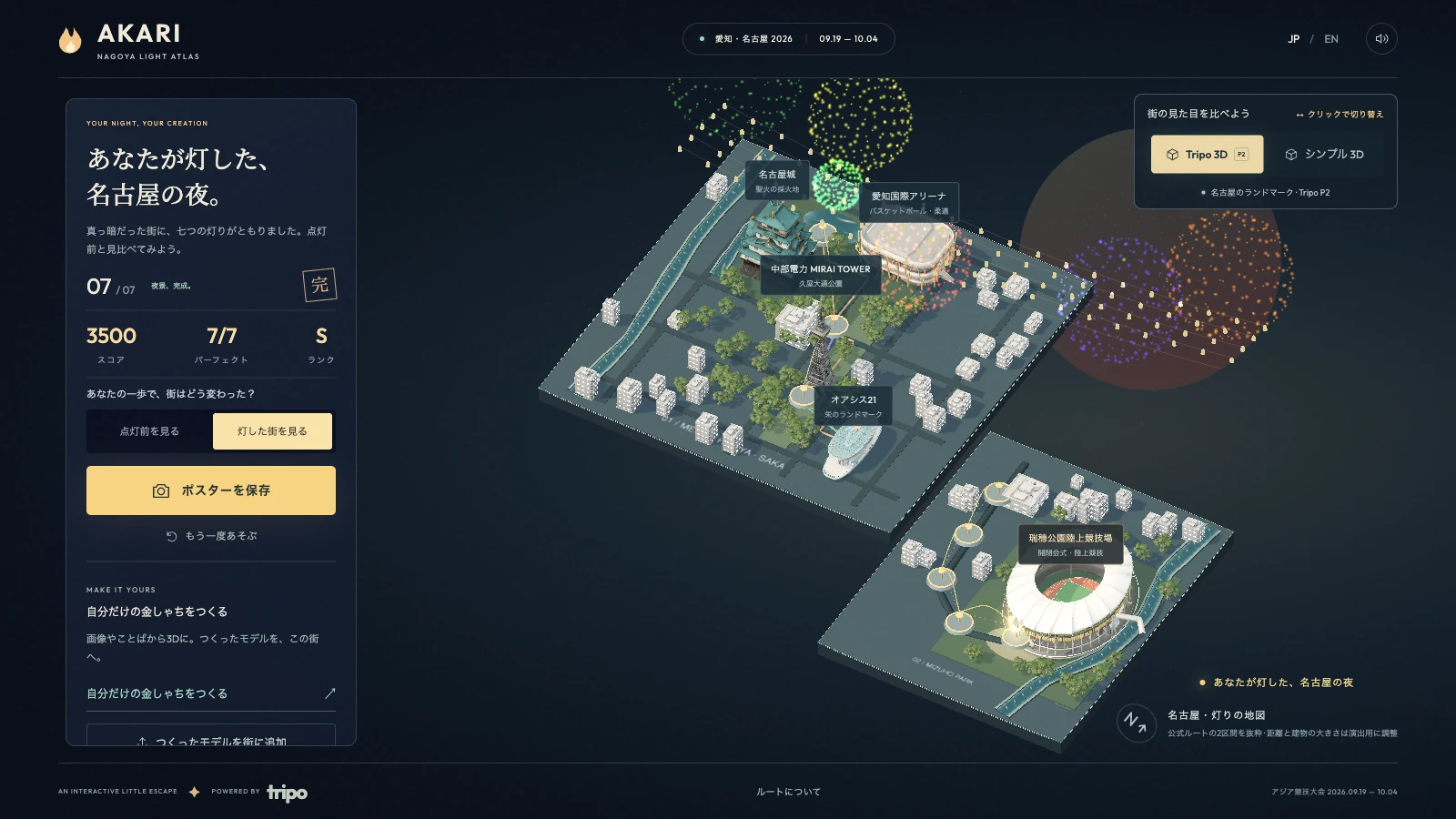
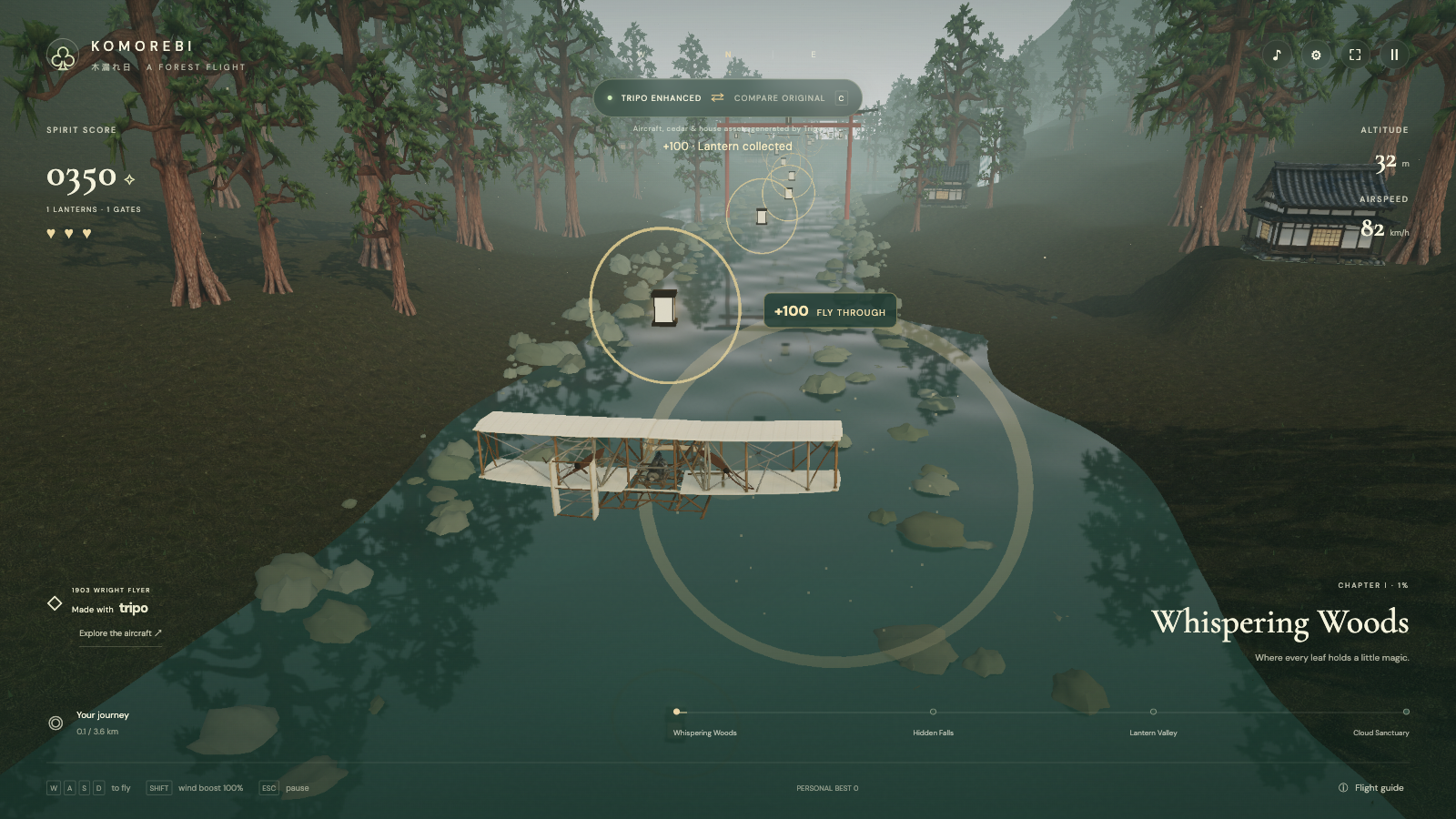
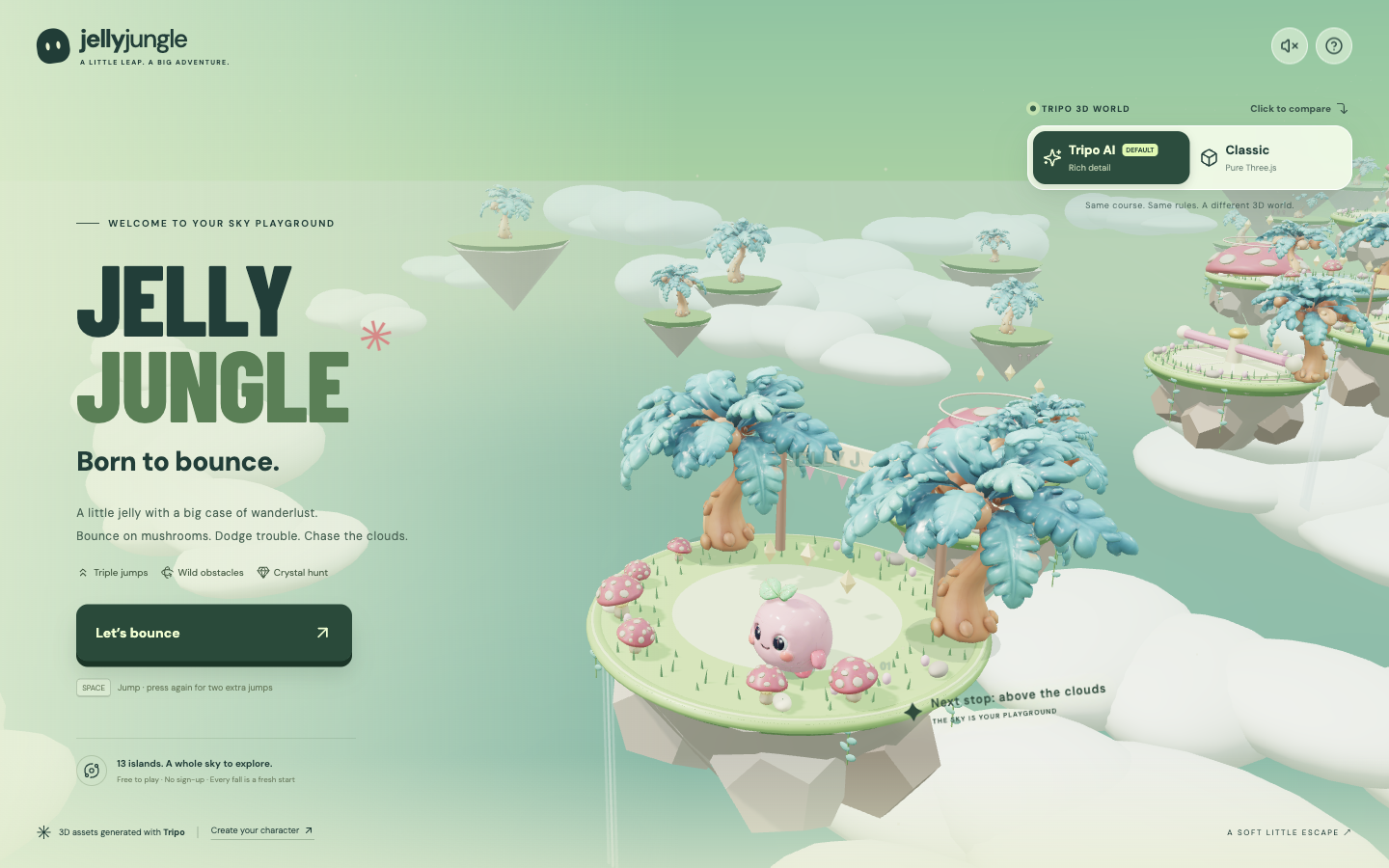
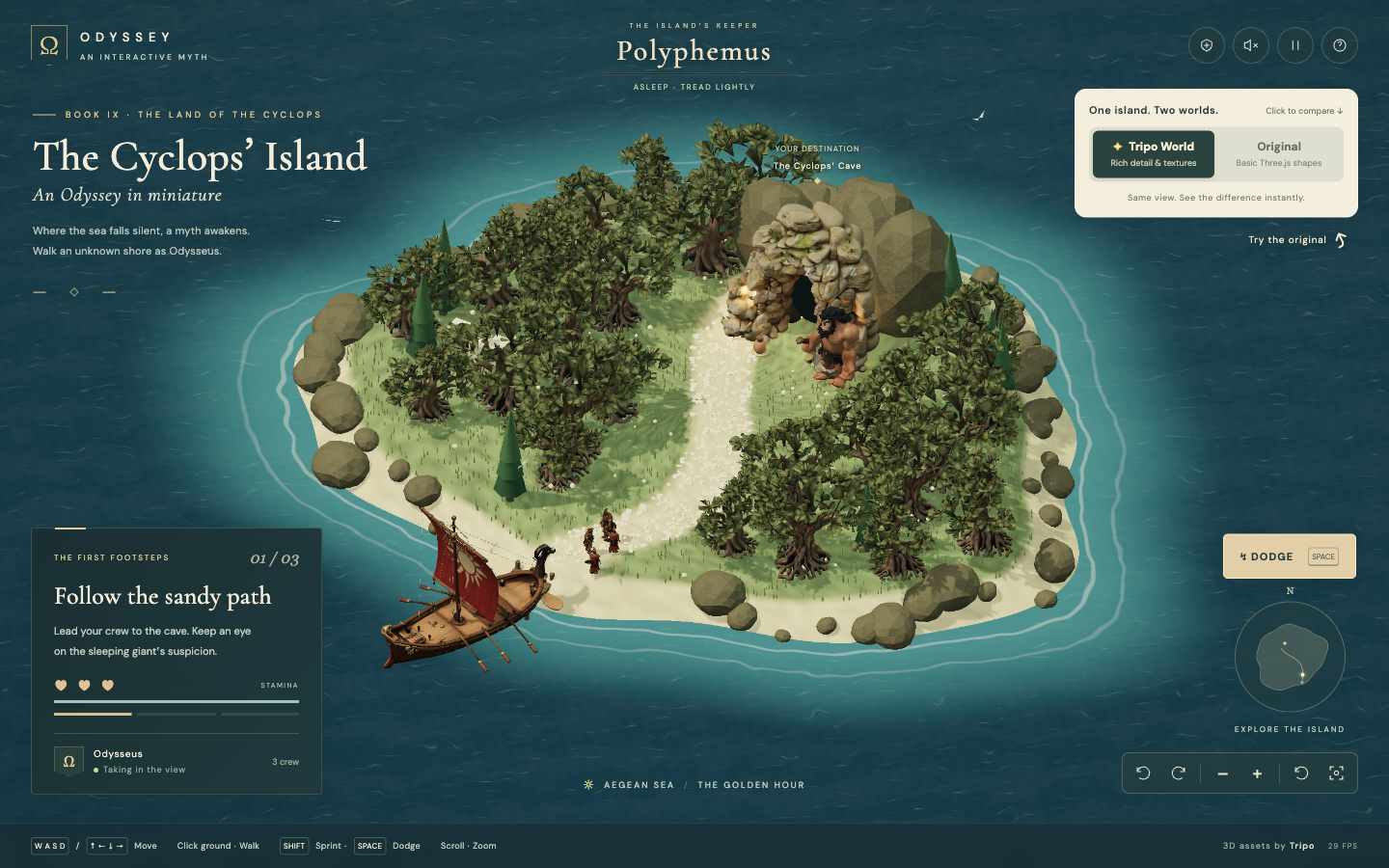
Create a complete Japanese-first Three.js game: leap across rooftops, illuminate Nagoya and save a festival poster. Start with procedural assets, then upgrade through Tripo Studio without an API key.
Created by Jared
About this example
A starting brief based on the creator's public project, not a verbatim original prompt. Your result will vary.
Reconstruction prompt based on Jared’s AKARI game.
Creator notes
Paste the complete brief into your coding Agent. It should first build and test a playable procedural game, including Japanese and English interfaces, seven jumps, a city-lighting finale and poster export. No Tripo API key or reference image is needed. After it runs, follow the optional asset guide: generate a shachihoko, then a castle in Tripo Studio; download textured GLB models using the options available to your account and import them into the matching slots. For image-to-model, ask the host Agent to generate a clean reference image and upload it in Studio. All Studio links include this Prompt slug for attribution.
Three.jsBrowser gameNagoyaOne-shot promptTripo 3DShachihokoProcedural gameNo API key
The prompt
# AKARI — Nagoya Light Atlas
## 1. Goal
Build a complete Japanese-first browser game in which an abstract flame makes seven timed jumps, lighting a miniature Nagoya before the Aichi–Nagoya Asian Games, 19 September–4 October 2026. Match the current two-map opening edition at https://akari-nagoya-rooftop-relay.tripo.page/ and the supplied visual references. The earlier generic rooftop scene is not the target.
## 2. Visual direction
Use an elevated three-quarter atlas view, midnight navy background, warm ivory Japanese serif headlines, fine gold lines and restrained grain. On desktop, reserve the left third for the opening invitation and frame two raised map tiles on the right; on phones, reframe the map above the controls. Begin with dim, desaturated buildings and teal waterways. Success restores greens, turquoise copper roofs, warm windows and gold route lights. Keep the flame and next target readable. Use soft shadows, atmospheric depth and controlled bloom; avoid white glare. Match the Japanese opening headline, landmark labels and slim editorial header/footer visible in the reference.
## 3. World
The larger northwest tile covers Meijo Park, Nagoya Castle, Aichi International Arena, Hisaya-odori Park, MIRAI TOWER and Oasis 21. The southeast tile covers the City Museum, Mizuho-dori, Mizuho Park and its athletic stadium, with Yamazaki River east of the stadium. Add low modern neighbourhoods, park trees, road markings, riverbanks and warm light fixtures; reserve castle architecture for the castle.
Chapter 1: Meijo Park → Sotobori/Hisaya-odori → Hisaya-odori Park → Oasis 21, three jumps. Make a clearly signposted, non-playable chapter transfer to the City Museum. Chapter 2: City Museum → Mizuho-dori → Mizuho Undojo Nishi → toward Mizuho Park → South Plaza, four jumps. Never draw the transfer as a continuous street or count it as a jump. Save progress at the second chapter. The maps use different scales with distances compressed for play. Explain this briefly in About, alongside the historical relay dates, 22 August and 16 September 2026; they are not upcoming event invitations. Cite https://www.aichi-nagoya2026.org/ja/torch-relay/ and https://www.nagoyajo.city.nagoya.jp/guide/kinshachi/. Use original ornaments and an abstract flame rather than an official mascot or emblem.
## 4. Asset inventory
Use these stable replacement slots in priority order; retain the same layout and collision proxies in both visual modes:
- `shachi`: antique polished-gold roof ornament with a tiger-like head, curved scaled carp body and upward curling tail; repeat on the castle.
- `castle`: ivory Nagoya-inspired keep, dark timber, stepped turquoise hip-and-gable roofs and stone foundation.
- `mizuho`: broad oval athletic stadium, pale open-centre roof and rhythmic supports; keep the running track and green field visible through the centre.
- `arena`: low contemporary arena with a broad roof and warm vertical facade fins, north of the park axis.
- `tower`: slender silver lattice observation tower with a box-like deck and antenna.
- `oasis`: elongated oval turquoise glass/water canopy on slim pale supports.
- `midrise`: restrained modern Japanese neighbourhood building; reuse with varied height and orientation, including simple museum massing.
- `tree`: compact mature park tree with a brown trunk and layered green crown; instance throughout both tiles.
Keep terrain, roads, water, track markings, jump markers, abstract flame, light trails, fireworks and UI procedural. Each model must be a complete isolated object; preserve open passages and the stadium centre. Track every listed slot, including repeated background assets.
## 5. Gameplay and reward
Hold pointer/touch or Space to charge; release to jump automatically toward the next marker. Use deterministic delta-time physics: distance = 1.8 + 7 × charge, charge reflects between 0 and 1, and the arc adds 4 × t × (1 − t) × 3.6 to interpolated height. The charge cycle speeds up from about 1.42 to 0.92 seconds per direction. Derive the trajectory, green safe zone and gold perfect zone from the same calculation: error ≤0.36 is perfect; ≤1.15 is safe, with 0.28 extra forgiveness for the first two jumps.
A safe landing gives 100 points; perfect gives 200 × consecutive multiplier, capped at ×4. A prompt follow-up within 2.35 seconds adds 50; reset combo after a safe landing, chapter transfer or 3.4 seconds of waiting. Each success sends a light wave through the district, illuminates windows and adds lanterns. Show seven-step progress, score, combo and best. Misses restart quickly; after the transfer restore the chapter checkpoint. Provide pause, restart, hidden-tab recovery and optional sound after interaction.
After the final jump, reveal both illuminated maps with a 4.6-second pullback and bounded fireworks. Show rank S for seven perfect landings, A for four or more, otherwise B. Include replay, same-camera before/after city views and a real 1800×1200 PNG poster with title, dates, score and independent-project credit.
## 6. Implementation
Use Vite, TypeScript and Three.js; separate geography, pure physics/scoring, scene, effects, model registry, Japanese/English localization and UI. Japanese remains the default regardless of prompt language; persist the language switch. Bundle fonts and assets locally. Use GLTFLoader and per-slot normalization; keep the last working model after an invalid import. Preserve score, checkpoint, camera and lighting when comparing simple and imported visuals. Instance trees/buildings, merge compatible static geometry, cap DPR and bound particles. Evaluate actual frame time and model complexity instead of rejecting a model just for exceeding a triangle target. Use Blender only if a returned asset needs mesh cleanup, pivot repair or an open stadium centre; preserve its original file.
## 7. Acceptance
Deliver runnable source, lockfile, development/build commands and a static build. Verify seven jumps across both chapters, transfer/checkpoint recovery, miss/retry, scoring, touch input, pause, Japanese/English persistence, all slot fallbacks and actual poster export. Compare settled opening and finale screenshots against the current two-map reference. Report measured performance and tests actually performed. The following shared workflow governs model generation and return.
How to use this prompt
01
Start with the right workspace
Open your preferred coding assistant or 3D tool. Use the model shown on the example as a starting point, and check any linked project for setup instructions.
02
Choose one thing to change
Swap the subject, art style or setting. Keep the camera and interaction clear. Build a small version first, then refine one detail at a time.
03
Give the scene its own assets
For a custom character or prop, create a 3D model from a short object description or reference image, then bring it into your project.
Previews belong to their respective creators. Check the original source and project license before reusing code or assets.