AAA CGI Supernatural Fight Short Set in an Underground Station
The creator says they used Chinese text prompts with no attachments to produce a 30-second video in an AAA fantasy game CGI style through GPT-6 Astra and Seedance 2.5. The prompt calls for continuous close-quarters combat between a goggle-wearing warrior and a scaled, ridged beast in a modern underground railway station, with strict control over character consistency, camera work, action physics, environmental destruction, and diegetic sound only.
A starting brief based on the creator's public project, not a verbatim original prompt. Your result will vary.
Creator notes
Create a 30-second AAA fantasy game CGI-style action short: in a dim modern underground railway station, a goggle-wearing warrior engages in continuous close-quarters combat with a scaled, ridged beast bearing verdigris-green armor plates on its left shoulder. Organize spinning kicks, arm locks and throws, flying kicks, pillar impacts, back handsprings, shoulder throws, combinations of short punches, and the final launch by precise time segments. Maintain character appearance, left-right identifying features, environmental damage, and spatial continuity. Every impact, jump, flight, and wall-bracing action must show clear contact, weight, inertia, and direction. Use fast dynamic camerawork, with localized slow motion only at the specified action beats. No background music, dialogue, subtitles, titles, readable text, logos, watermarks, or interfaces; use only diegetic underground-station audio synchronized with the visuals.
AAA fantasy game CGIunderground railway stationsupernatural combataction shortgoggle-wearing warriorscaled ridged beastcharacter consistencydynamic cinematography
The prompt
All characters, background extras, and the station environment share a clearly digitally sculpted, high-end AAA fantasy game CGI look. Character close-ups must retain polished game-character faces, clearly defined braided hair strands, and stylized realistic skin; they must not become live-action actors, cosplay, ordinary gameplay, 2D animation, or cel-shaded art. Keep the supernatural fight in a modern underground station; do not change the setting to a medieval castle, snowy mountains, or a boxing ring. The palette is desaturated cool teal-gray, deep charcoal black, blue-gray scales, and cool-white light strips, with small areas of yellow guardrails, red signal lights, bronze goggle frames, verdigris-green shoulder armor, and ochre-red waistbands. The eyes' honey-gold glow and the brief purple flash when striking a pillar appear only at their specified moments; do not tint the entire film purple.
Environment: a spacious, dim underground railway station with a sunken central track area, rails, and ballast, and platforms raised on both sides. Platform edges have glass-and-metal safety barriers with yellow vertical frames. The floors have yellow safety lines, gray tile, and drainage grates. Thick white round columns support the low ceiling. Continuous cool-white strip lights and circular lamps run overhead, with small red signal lights receding into the distance. Dozens of adult passengers in ordinary light- and dark-colored coats are scattered beside columns or behind barriers. Startled by the fight, they retreat, crouch, and raise their arms for protection, remaining background extras at all times: they do not join the fight, become main characters, or share identical faces. No train enters the station. Signs contain only blurred geometric color blocks with no readable text.
The two fighters remain fixed. A, the goggle-wearing warrior, is a tall, lean, athletic adult man with warm deep-brown skin, defined cheekbones and jawline, and short black close-cropped braids gathered into a short braid knot at the back of his head. A narrow bronze-framed, smoke-gray flip-up goggle visor is fixed across his forehead. It normally covers his eyes, leaving the bridge of his nose and mouth visible. He wears a gray-blue sleeveless crossover-neck combat top, a dark brown waist sash, charcoal-black trousers, and dark brown low-top boots. Both forearms are wrapped in gray cloth. His fingers remain exposed and his hands are always empty: no cape, handheld weapons, or readable insignia. His expression is calm and his movements are agile and decisive. Only in the specified shot does he briefly raise the visor edge with his right hand, revealing one bright honey-gold eye, then lower the visor back over his eyes. This is the same physical visor fixed to his forehead throughout; it must not turn into cloth strips or disappear.
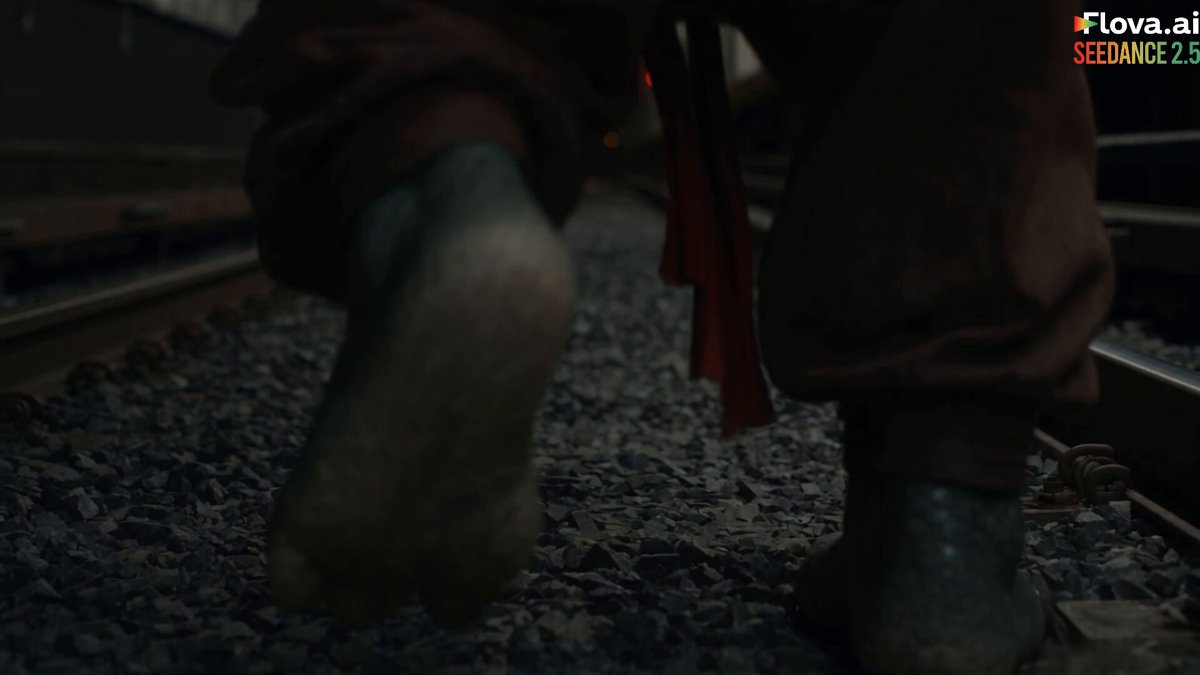
B, the scaled ridged beast, is a muscular bipedal humanoid creature taller and broader than A. Coarse dark blue-gray scales cover its broad chest, back, and limbs, while finer gray-blue scales cover its abdomen. It has a broad, flat lizard-like head, a short blunt snout, a heavy jaw, two deep amber eyes, and short, blunt teeth. It has no human hair, mask, or branch-like protrusions. Thick natural verdigris-green armor plates grow from B's left shoulder to left forearm, with a row of short, blunt bone fins fixed along the top of the left shoulder. The right arm retains lighter gray-blue coarse scales; never swap the left and right sides. The fins and armor plates are part of the body, and there are no flowers on the shoulder. B wears loose dark-brown wide-leg fighting trousers, an ochre-red fabric belt with two narrow hanging tails, and dark-brown cloth wrapped around the ankles. Its broad feet are scaled, with clearly defined soles suitable for bracing against a wall. It has no tail, wings, extra arms, long horns, sword, spear, shield, or handheld props. B is a large beast that can move through a normal station, maintaining a stable scale relative to A and the passengers; it must not swell into a skyscraper-sized giant.
0.00–3.70 seconds: Enter the confrontation on the very first frame. A brief low-angle shot close to the tracks shows B rapidly stepping forward, then cuts to a medium shot behind A as B charges from the front, raises a leg, rotates its hips, and throws a head-height spinning side kick. A bends his knees, lowers his head, and tilts his torso aside as the kick passes above his short black braids. B plants its foot and turns back, while A immediately rises. Cut to a clearly Dutch-angled, low track-level wide two-shot. A raises a knee and follows with a high side kick; B lowers its head and shoulders to evade it, and A retracts the leg, returning it to a supporting stance. Cut back to a close follow shot over A's shoulder. B catches up with a continuous series of swinging punches. A avoids them with short head slips, shoulder dips, and turns, letting the punches skim past his face. Do not have A stand still while B repeatedly swings at him. Ceiling light strips whip through the frame with directional motion trails, while the spatial relationship between the bodies remains clear.
3.70–6.40 seconds: B's light gray-blue right fist extends toward A's face again. A catches the wrist and forearm with an open hand; the point of contact must be visible. The camera moves close to A's calm profile, then follows as he pivots his feet, rotates his hips and shoulders, and quickly moves into a low full-body angle. A keeps hold of the same right arm, pulls B off its base, and swings it up along the side of his body. Both of B's feet leave the ground, with the ochre-red belt and wide trousers lagging behind from inertia. At the highest point of the swing, use only a very brief ultra slow motion, then return to high speed. After completing the rotation, A releases B. B flips down headfirst along the same arc, shoulder and back striking the track bed as ballast and dust burst from the contact point. The low camera follows the fall and shakes briefly. B rolls with the momentum and props up its torso, keeping all four limbs intact. No severed arm, contactless telekinetic throw, or standing up from nowhere.
6.40–9.20 seconds: B is still recovering low to the ground when A has already pushed off and leapt in. From behind B, the camera tilts upward to show A rotating his hips and extending his leg in midair. Briefly slow motion at the apex, then as A descends, drive a lateral flying kick into B's head and shoulder. B raises both arms to block and is forced off balance. A follows immediately after landing; do not have him land and wait. The camera closes in quickly as it follows A's descent and arcs around the side, alternating slightly tilted over-the-shoulder and facial close-ups. A slips past B's returning arm, punches the torso with a short strike, then uses an open palm to push the side of B's face, turning B's head aside only after contact and in the direction of the push. The palm, face, and forearm must remain separate and clearly defined. B's left-shoulder bone fins rotate with the same-side shoulder armor and torso.
9.20–11.20 seconds: Using the space created by the facial push, A turns and retracts his leg, then drives a powerful side kick forward. The sole contacts B's abdomen to lower chest. B's torso folds first, then both feet leave the ground as it flies upward and sideways toward the platform. The camera follows B skimming over the platform edge. B's upper back and shoulder slam into a white column. The column cracks outward from the contact point, shedding pale fragments and dust, and B slides down the column onto the platform floor. After retracting his leg, A leaps from the track area onto the same platform and closes in. After the cut, he appears in a continuous position beside that column, not teleported to another station. Passengers scatter to both sides. The column is damaged but does not collapse completely.
11.20–12.80 seconds: Cut to a close-up of B's face after the impact. It lifts its head and turns to search for A, with the left-shoulder verdigris armor plates and short bone fins still present. Quickly shift to a close composition on opposite sides of the same column: B occupies the right foreground, while A stands behind and to the left beside the column, wearing a slight cold smile but saying nothing. A raises the edge of the bronze-framed visor with his right hand, revealing one bright honey-gold eye and looking directly at B for a very brief moment. He lowers the visor with his right hand so it covers his eyes again, simultaneously preparing to evade. Do not leave a pause for nonexistent dialogue or animate a speaking mouth.
12.80–13.80 seconds: B turns its shoulder and swings its light gray-blue right fist toward A's position. Before the fist arrives, A quickly sidesteps around behind the column. The fist hits the solid white column, producing a compact purple energy flash at the moment of contact. Cracks extend, debris falls, and the brief purple light immediately disappears. The close-up first shows the fist pressing into the column surface, then quickly widens to reveal that B has missed and A has already moved around to the side. It remains the same previously damaged column. Do not turn A into purple smoke or let the fist pass through a body.
13.80–16.00 seconds: In a low, tilted wide shot, A crouches in front and to the side of the column and makes a brief beckoning gesture. B turns and charges. A pushes off and completes one continuous back handspring: first arching backward, sending both feet up over his head, then tucking through the inverted phase to evade B's sweeping arm. The camera tilts upward with the body; briefly slow motion during the inverted phase as the light strips slant across the background. A continues the same rotation, brings both feet back beneath his body, and lands in the open platform space behind B, bending his knees to absorb the landing. His clothing hem and short rear braids settle with the inertia. Frightened passengers dodge in the background; they are not additional attackers. A is not knocked away and does not repeat flips in midair to pad the duration.
16.00–18.50 seconds: As soon as A stands, B turns and catches up with a broad swing toward the side of A's head. A first leans back, then ducks under B's light gray-blue right arm as it passes overhead. He controls the forearm with both hands, steps into the front of B's body, and turns his back while lowering his center of gravity. A guides B's arm over his shoulder and uses B's continued forward momentum to complete a shoulder throw. B's hips rotate over the fulcrum, both feet leave the ground, and its back lands on the platform tiles as broken tile and dust spread along the floor. The camera pulls from a tight shoulder shot to a low medium-wide shot, clearly showing the rotation and landing. A remains standing and releases B to the ground. B immediately rolls, props itself up, bends its legs, and rises. A turns toward it and continues the pressure, linking the recovery to the pursuit without a long pause for standing dialogue.
18.50–20.65 seconds: B rushes back into close range. A strikes first with a short straight punch toward the side of the face, retracts to guard his chest, then lowers his body and punches toward the abdomen and ribs. B raises an arm to block one strike and counters with a heavy horizontal sweep. A stays inside B's chest and shoulder line, dips his head to evade, uses his forearm to knock aside the retracting punch, and follows with compact short punches contacting the jaw and upper chest. The camera makes fast, small movements around the two fighters' shoulders. Heads and bodies recoil only after actual contact. Complete this section as a continuous exchange of attacks, blocks, parries, and counters; do not show them taking turns throwing punches into empty space, failing to react, or keeping both fists pressed together.
20.65–21.85 seconds: Cut directly to a clear overhead shot. The two fighters move around the same small patch of floor tiles. A's black short braids and bronze visor frame, along with B's left-shoulder verdigris armor plates and ochre-red belt, remain fixed identifying features. B's broad arm sweeps past A's side. A hunches his shoulder and slips inside the arm, changing foot position one step at a time. One hand knocks aside B's forearm while the other punches into the chest and abdomen, then retracts as A adjusts position with B's rotation. Fallen tiles and the drainage grate remain in their original positions. Use the overhead shot to show the close-quarters attack-and-defense route; do not add a double or third fighter.
21.85–24.00 seconds: Cut back to a tight shot over B's shoulder. A continues a series of short alternating high and low punches while slipping his head away from B's arm swinging down from above. The wrapped forearms and gray-blue scaled arm cross, but their boundaries remain clear. The camera follows A's punches driving forward. At two strong contact points, add only a few frames of high-contrast black-and-white exposure flashes with dimensional impact contours, then immediately return to the original cool blue-gray AAA CGI look. Do not cut to comic-book art, text, or a 2D illustration. The final straight punch clearly compresses B's abdomen inward. Its torso folds, and the arm swinging down from above loses forward direction with the torso. A's feet remain planted, with force traveling through the legs, hips, and shoulder into the fist. The fist does not pass through the body.
24.00–28.00 seconds: Immediately continue with the aftermath of the same heavy abdominal strike. Both of B's feet leave the ground as it flies backward. The camera tracks rapidly along the station's long axis, low and close to the platform edge, sweeping past white columns, yellow frames, glass barriers, and startled crowds. Background lines stretch with speed. B's blue-gray scaled body, dark-brown trousers, ochre-red belt, and left-shoulder verdigris armor plates remain recognizable throughout. Use long-axis wide shots, rapid cuts with columns brushing past the foreground, and low upward-looking close-ups to show B rotating through the inertia and extending its arms to regain balance. Debris it kicks up travels along the same flight direction over the tracks. B then crashes through a section of the platform's glass-and-metal safety barrier. The glass breaks upon body contact and the metal frame bends. B continues through the opening into the track area, then cut to a wide shot facing the track-side wall. This remains one continuous flight caused by the preceding abdominal strike: do not add an off-screen kick, second launch, or passengers being knocked away. Do not duplicate A behind every column.
28.00–30.00 seconds: Use a locked-off lateral medium-wide shot. A dark-gray vertical track wall fills the left side of the frame, with the opposite platform and passengers behind the barriers in the right background. Long light strips point into the depths of the station. B rotates in the air until its feet face the wall. Both soles clearly contact the vertical wall. B bends its knees and tucks its abdomen into a compact crouch, scraping a small amount of wall dust from beneath its feet. It then slowly extends its knees in ultra slow motion, rotating its torso outward as its body gradually approaches horizontal. The soles remain braced against the wall. The ochre-red belt, wide trousers, and small fragments continue moving, showing the continuous process of contact, compression, and loading. This is not a back-first wall impact, a frozen hover, or standing on a horizontally overturned surface.
End exactly at 30.00 seconds with B still braced against the wall with both feet, its body opening outward in active motion. Do not add a complete wall-kick counterattack, landing, death, or victor/defeat resolution. No black screen, fade-out, or end card.
Pacing and continuity: preserve the sequence of rapid pursuit, close-range evasion, throws, flips, flying kicks, pillar impacts, overhead short strikes, and movement across the platforms. Shorten observation and nonexistent dialogue pauses. Use localized slow motion only at the highest point of the swing, the airborne evasion, and the final wall brace; explicitly use ultra slow motion for the final wall-brace phase. Normal exchanges must remain fast and fluid. Do not use global slow motion or freeze frames to pad the duration. Keep A's black short braids, deep-brown skin, bronze-framed visor, gray-blue sleeveless top, and wrapped forearms consistent. Clearly show the visor's covered and uncovered states before and after the eye reveal. Keep B's left-side verdigris armor plates and short bone fins, right-side gray-blue scaled arm, broad lizard-like head, dark-brown trousers, and ochre-red belt consistent. The fins must not fall off, switch sides, or become weapons. A fighter who is knocked down must contact the ground before recovering support. An active jump must begin with a push-off. A hit-driven flight must begin with contact. Wall braking must begin with the soles contacting the wall, followed by knee flexion. Every movement must retain weight, inertia, and direction. Background passengers continue making varied, natural evasive movements while maintaining clear spatial separation from the fighters; they must not merge with them or suddenly enter punch and kick paths. Damaged column surfaces, fallen tiles, and the broken barrier remain damaged in later shots.
No additional weapons, extra limbs, blood spray, or dismemberment.
Strictly prohibit background music: at no point may the film generate background music, a score, a music track, melody, rhythmic percussion, choir, song, sustained musical tone, or tonal atmospheric bed. Allow only diegetic audio synchronized with the visuals and physically belonging to the scene: underground-station ventilation and room reverberation, footfalls and foot scrapes, clothing and ochre-red belt movement, punches and kicks cutting through the air, dull impacts from actual contact, nonverbal breathing and brief grunts of pain, rolling ballast, cracking concrete, shattering glass, bending metal barrier frames, passengers' retreating footsteps, a brief non-melodic electrical crackle from the purple-light impact, and the final friction of soles braced against the wall with falling wall dust. No dialogue, narration, intelligible shouted words, songs, subtitles, or captions. Do not use pulsing sounds, orchestral hits, melodic sound design, or rhythmic effects to fill the absence of music. Do not arrange the combination punches, footsteps, or breaking glass into drumbeats, and do not extend ventilation noise into a musical sustained tone. Any background music or score is a failed result. music=0; no_music=1; strict_no_music=1; audio=diegetic_only; no title, readable station name, logo, interface, player controls, or watermark.
How to use this prompt
01
Start with the right workspace
Open your preferred coding assistant or 3D tool. Use the model shown on the example as a starting point, and check any linked project for setup instructions.
02
Choose one thing to change
Swap the subject, art style or setting. Keep the camera and interaction clear. Build a small version first, then refine one detail at a time.
03
Give the scene its own assets
For a custom character or prop, create a 3D model from a short object description or reference image, then bring it into your project.
Previews belong to their respective creators. Check the original source and project license before reusing code or assets.